The best automated clothing manufacturing machines depend on which production step slows your operation: for a versatile embroidery workhorse, my best overall pick is the BAI The Mirror 15-Needle Commercial Embroidery Machine, while the POOLIN EOV 15-Needle stands out for shops prioritizing multi-needle embroidery. For cutting fabric, the VEVOR 750W Industrial Fabric Cutting Machine addresses a different bottleneck, and the JACK F6 focuses on direct-drive lockstitch sewing. The main tradeoff is between buying a capable machine for one task and building a broader workflow across several specialized machines. I compare the options by production role, automation, usability, and fit for different shop sizes. Read on for the full breakdown and help matching a machine to your apparel work.

Get your wardrobe favorites delivered free with Prime
- Fast, free delivery on millions of items
- Prime Video, Amazon Music and more included
- Member-only deals all year
Key Takeaways
- Embroidery dominates this lineup: Most picks are multi-needle commercial embroidery machines, so buyers seeking a complete cut-sew-finish production line will need to plan for equipment beyond this selection.
- Needle count is not the whole decision: The 10-, 12-, and 15-needle models differ in how much color-change setup they may reduce, but hooping, design compatibility, support, and work area still shape practical throughput.
- Task-specific machines fill different bottlenecks: The VEVOR cutter, JACK F6 lockstitch machine, and thread-trimming and button-winding machines cannot replace embroidery equipment; they support separate production stages.
- The 15-needle group is the broadest embroidery tier: BAI The Mirror, POOLIN EOV, Poolin EOM-15, and Smartstitch S-1501 models are candidates for multi-color work, while 10-needle options may better match simpler designs or smaller operations.
- Automation brings setup and support needs: These machines still call for operator training, compatible designs and materials, maintenance, and adequate workspace; automation does not remove production planning.
| Industrial Dual-Head Automatic Thread Trimmer |  | Best for High-Volume Thread Finishing | Voltage: 110V / 220V | Power: 700W | Blade speed: Up to 7,500 RPM | VIEW LATEST PRICE | See Our Full Breakdown |
| POOLIN EOV 15-Needle Commercial Embroidery Machine |  | Best for Cap and 3D-Puff Work | Model: EOV-15 | Needles: 15 | Embroidery area: 14.2 × 9.5 inches | VIEW LATEST PRICE | See Our Full Breakdown |
| JACK F6 Industrial Sewing Machine – Single Needle Direct Drive Lockstitch with Table and Stand |  | Best for Core Garment Construction | Model: F6 | Stitch type: Single-needle lockstitch (301) | Maximum speed: 5,000 SPM | VIEW LATEST PRICE | See Our Full Breakdown |
| BAI The Mirror 15-Needle Commercial Embroidery Machine |  | Best for Large-Format Embroidery | Needles: 15 | Embroidery area: 20 × 14 inches | Maximum flat embroidery speed: 1,200 stitches per minute | VIEW LATEST PRICE | See Our Full Breakdown |
| Smartstitch S-1201 Plus 12-Needle Commercial Embroidery Machine | 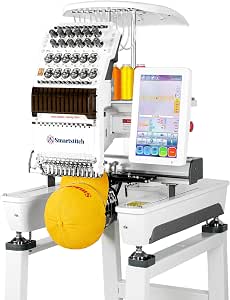 | Best for Multi-Material Embroidery | Needles: 12 | Maximum speed: 1,200 stitches per minute | Embroidery area: 12 × 16 inches | VIEW LATEST PRICE | See Our Full Breakdown |
| Smartstitch S-1501 Commercial Embroidery Machine |  | Best for Large Embroidery Designs | Needles: 15 | Embroidery area: 14 × 20 inches | Maximum speed: 1,200 SPM | VIEW LATEST PRICE | See Our Full Breakdown |
| MiyKom Automatic Brushless Thread Trimmer with 30 L Vacuum Bin |  | Best for Garment Finishing | Motor: Brushless | Power: 450 W | Listed speed range: 3,000–28,000 rpm; listing also gives a conflicting 2,800 rpm figure | VIEW LATEST PRICE | See Our Full Breakdown |
| LIAMOS SR-8 Automatic Garment Button Winding Machine |  | Best for Button Attachment Finishing | Model: SR-8 | Weight: 7.5 kg | Power: 6 W | VIEW LATEST PRICE | See Our Full Breakdown |
| Smartstitch S-1001 10-Needle Commercial Embroidery Machine |  | Best for Smaller Commercial Setups | Needles: 10 | Maximum speed: 1,200 stitches per minute | Embroidery area: 9.5 × 14.2 inches | VIEW LATEST PRICE | See Our Full Breakdown |
| Poolin EOM-15 15-Needle Commercial Embroidery Machine |  | Best Complete Startup Package | Needles: 15 | Flat embroidery speed: Up to 1,200 SPM | Cap embroidery speed: Up to 850 SPM | VIEW LATEST PRICE | See Our Full Breakdown |
| Automatic Multi-Needle Embroidery Machine for Apparel and Caps |  | Best for Broad Garment Variety | Type: Computerized embroidery machine | Needles: 12 or 15; customizable | Embroidery applications: Caps, shirts, flat garments, socks, gloves, jackets, sleeves, and bags | VIEW LATEST PRICE | See Our Full Breakdown |
| FUJA FJ-1001 10-Needle Commercial Embroidery Machine |  | Best Starter Package for a Growing Shop | Model: FJ-1001 | Needles: 10 | Maximum speed: 1,200 SPM | VIEW LATEST PRICE | See Our Full Breakdown |
| Smartstitch S-1501 Ultra 15-Needle Embroidery Machine |  | Best for High-Capacity Cap Work | Model: SS-EM-1501-UL01 | Needles: 15 | Maximum speed: 1,200 SPM | VIEW LATEST PRICE | See Our Full Breakdown |
| VEVOR 750W Industrial Fabric Cutting Machine with 9.8-inch Alloy Steel Blade and Automatic Sharpening |  | Best for Automated Layer Cutting | Power: 750W | Motor type: Series-excited pure copper | Cutting speed: 2,950 RPM | VIEW LATEST PRICE | See Our Full Breakdown |
| Ricoma EM-1010 10-Needle Commercial Embroidery Machine |  | Best Connected 10-Needle Pick | Model: EM-1010 | Needles: 10 | Embroidery area: 12.2 × 8.3 inches | VIEW LATEST PRICE | See Our Full Breakdown |
| automated clothing manufacturing machine | Needles | Embroidery area | Connectivity |
|---|---|---|---|
| Industrial Dual-Head Automatic | — | — | — |
| POOLIN EOV 15-Needle Commercia | 15 | 14.2 × 9.5 inches | Wi-Fi and USB |
| JACK F6 Industrial Sewing Mach | — | — | — |
| BAI The Mirror 15-Needle Comme | 15 | 20 × 14 inches | — |
| Smartstitch S-1201 Plus 12-Nee | 12 | 12 × 16 inches | Wi-Fi |
| Smartstitch S-1501 Commercial | 15 | 14 × 20 inches | Wi-Fi and USB |
| MiyKom Automatic Brushless Thr | — | — | — |
| LIAMOS SR-8 Automatic Garment | — | — | — |
| Smartstitch S-1001 10-Needle C | 10 | 9.5 × 14.2 inches | USB and Wi-Fi |
| Poolin EOM-15 15-Needle Commer | 15 | 14.2 × 9.5 inches | Wi-Fi and USB |
| Automatic Multi-Needle Embroid | 12 or 15; customizable | — | — |
| FUJA FJ-1001 10-Needle Commerc | 10 | 9.5 × 14.2 inches | USB, WiFi |
| Smartstitch S-1501 Ultra 15-Ne | 15 | 20 × 14 inches | WiFi, USB |
| VEVOR 750W Industrial Fabric C | — | — | — |
| Ricoma EM-1010 10-Needle Comme | 10 | 12.2 × 8.3 inches | USB, LAN, WiFi |
More Details on Our Top Picks
Industrial Dual-Head Automatic Thread Trimmer
For a production line where loose thread cleanup slows garment finishing, I’d give this dual-head trimmer a distinct role: it lets two operators trim at once, unlike the JACK F6, which handles the lockstitching itself. Its 7,500 RPM Wolfram steel blades are specified for thick fabrics, knitwear, socks, and layered textiles, while adjustable suction collects cut threads as operators work. Automatic oil supply and overheating protection also suit longer production runs. The tradeoff is specialization: this machine finishes threads but does not sew, cut garment panels, or add embroidery. Suction needs careful adjustment around lightweight material, and its industrial setup is a poor match for occasional home sewing. I’d shortlist it for factories seeking a dedicated finishing station, not as a standalone clothing-making machine.
Pros:- Two cutting heads let two operators work simultaneously.
- Blade design and stated material range suit thick and layered textiles.
- Adjustable suction collects loose threads during trimming.
- Automatic oil supply and overheating protection support extended operation.
Cons:- It performs thread finishing only and cannot replace a sewing or fabric-cutting machine.
- Airflow needs adjustment to keep lightweight fabric from being drawn toward the blades.
- Its industrial configuration may be excessive for home or low-volume use.
Best for: Garment workshops with two operators who need to remove loose threads from thick, layered, or knitted production efficiently.
Not ideal for: Home sewists and small studios handling mostly lightweight fabric, where the industrial setup and suction-adjustment needs may outweigh the time saved.
- Voltage:110V / 220V
- Power:700W
- Blade speed:Up to 7,500 RPM
- Maximum suction motor speed:Up to 15,000 RPM
- Blade material:Wolfram steel
- Cutting method:Automatic thread cutting and suction
- Lubrication:Automatic oil supply
- Airflow adjustment:Supported
- Recommended materials:Thick fabrics, knitwear, socks, and woven textiles
Our verdict“Choose it when two-person thread cleanup is a production bottleneck, but pair it with sewing equipment such as the JACK F6.”
POOLIN EOV 15-Needle Commercial Embroidery Machine
The POOLIN EOV earns its place for shops whose apparel orders include structured caps as well as flat embroidery. Its 15-needle setup reduces manual color changes, and the included cap station, cap drive, and two cap hoops make that specialty more accessible than on a flat-focused setup. Compared with the BAI The Mirror, the EOV has a smaller listed embroidery area and lower maximum speed, but its cap equipment and guided after-sales support give it a clear production niche. A 9-inch touchscreen plus Wi-Fi and USB transfer provide two ways to load designs. The tradeoff is its large, floor-standing commercial footprint; it is not a compact hobby machine. Buyers should also plan around a one-year warranty and confirm the workspace can accommodate the machine and its cap workflow.
Pros:- Fifteen needles reduce repeated thread changes on multicolor designs.
- Cap station, cap drive, and two cap hoops support structured-cap work.
- Wi-Fi and USB provide flexible design-transfer options.
- Guided after-sales support can help commercial buyers with setup and operation.
Cons:- The floor-standing commercial setup demands dedicated workspace.
- Its 14.2 × 9.5-inch embroidery area is smaller than the BAI The Mirror’s listed 20 × 14-inch field.
- The stated one-year warranty is a defined support window for a production machine.
Best for: Small apparel businesses producing custom caps and multicolor garments that need a commercial multi-needle workflow and setup guidance.
Not ideal for: Hobbyists with limited floor space or shops prioritizing a larger flat embroidery field, where the BAI The Mirror offers a bigger listed area.
- Model:EOV-15
- Needles:15
- Embroidery area:14.2 × 9.5 inches
- Maximum speed:1,000 SPM
- Cap rotation:270°
- Display:9-inch touchscreen
- Connectivity:Wi-Fi and USB
- Included hoops:5 standard hoops and 2 cap hoops
- Warranty:1 year
Our verdict“Pick the EOV if cap embroidery and included cap tooling matter more than the larger flat field offered by the BAI The Mirror.”
JACK F6 Industrial Sewing Machine – Single Needle Direct Drive Lockstitch with Table and Stand
Unlike the embroidery-focused POOLIN EOV and BAI The Mirror, the JACK F6 handles a core garment-making task: joining fabric with a single-needle lockstitch. Its direct-drive servo motor reaches 5,000 stitches per minute, while the integrated drive avoids belt friction and is described as low in noise and vibration. For a shop sewing light- to medium-weight material, the included table, stand, LED light, and needle positioner make this a more complete station than a machine head alone. Its limits are just as relevant: the listed fabric range does not cover heavy production materials, and it cannot add decorative embroidery. The machine ships disassembled, so setup takes work before production begins. I’d rank it as a practical construction station, not an all-in-one automated clothing line.
Pros:- Direct-drive servo motor offers speeds up to 5,000 stitches per minute.
- Machine head, table, stand, and accessories are included as a complete station.
- LED lighting and automatic needle positioning support repeatable sewing workflows.
- Direct-drive construction avoids belt friction and is described as low in noise and vibration.
Cons:- Ships disassembled and requires user assembly.
- The stated fabric suitability is limited to light- and medium-weight materials.
- Single-needle lockstitching does not provide embroidery or multi-needle color changes.
Best for: Tailoring shops and small apparel producers sewing light- to medium-weight fabrics who need a complete lockstitch station with a table and stand.
Not ideal for: Manufacturers focused on heavy textiles, caps, or decorative embroidery; the F6 is limited to a single-needle lockstitch and light- to medium-weight fabric.
- Model:F6
- Stitch type:Single-needle lockstitch (301)
- Maximum speed:5,000 SPM
- Motor:Integrated direct-drive servo motor
- Needle system:DB×1 (#11–#18)
- Maximum stitch length:5 mm
- Voltage:110V AC
- Dimensions:20 × 47 × 48 inches (D × W × H)
- Included components:Machine head, industrial table top, stand/legs, servo motor, and accessories
Our verdict“Choose the F6 for fast, light- to medium-weight garment construction, not for embroidery or heavy-fabric work.”
BAI The Mirror 15-Needle Commercial Embroidery Machine
Among these embroidery machines, The Mirror is the pick I’d favor when large flat designs matter more than a smaller footprint. Its 20 × 14-inch field exceeds the POOLIN EOV’s 14.2 × 9.5-inch area and the Smartstitch S-1201 Plus’s 12 × 16-inch area, giving apparel decorators more room for oversized placements. Fifteen needles limit manual rethreading across multicolor jobs, and the machine supports both flat work and structured caps. Institch OS5 controls, included software, training, and local technical support give small businesses more than a bare production head. The tradeoff is substantial: at 391 pounds, it requires a stable, dedicated location, and cap speed is lower than flat speed. Occasional creators may find this commercial scale hard to justify.
Pros:- The 20 × 14-inch embroidery area is larger than the POOLIN EOV and Smartstitch S-1201 Plus fields.
- Fifteen needles reduce thread changes on multicolor jobs.
- Supports both flat embroidery and structured caps.
- Includes software, accessories, training, and local technical support.
Cons:- At 391 pounds, it requires a permanent, sturdy installation area.
- Maximum cap speed of 850 stitches per minute is below its 1,200-stitch flat speed.
- Its commercial scale may be unnecessary for occasional or small-format work.
Best for: Commercial apparel decorators producing large flat designs and cap work who have space for a heavy, dedicated embroidery machine.
Not ideal for: Home creators or small studios needing a portable machine, or businesses whose work rarely fills a large embroidery field.
- Needles:15
- Embroidery area:20 × 14 inches
- Maximum flat embroidery speed:1,200 stitches per minute
- Maximum cap speed:850 stitches per minute
- Controls:Institch OS5 touchscreen
- Dimensions:27.6 × 29.5 × 33.2 inches (D × W × H)
- Weight:391 pounds
- Power source:Corded electric
Our verdict“Choose The Mirror when large embroidery placements and commercial support justify a heavy, fixed installation.”
Smartstitch S-1201 Plus 12-Needle Commercial Embroidery Machine
The S-1201 Plus suits decorators who need one machine to move among apparel, accessories, and tougher materials. Its listed applications include denim, canvas, leather, vinyl, caps, shoes, and bags, a broader material mix than the JACK F6’s light- to medium-weight sewing focus. Automatic color changing and thread trimming, thread-break detection, and laser positioning reduce some manual interruptions, while Wi-Fi and a 10-inch touchscreen support design handling. Its 12 × 16-inch field is useful for larger work, though the BAI The Mirror provides a wider 20 × 14-inch area and 15 needles. That makes the Smartstitch a more flexible multi-material choice, not the largest-format option. Buyers also face practical unknowns: the listing omits weight and power consumption, and says to retain the pallet and packaging for a potential return.
Pros:- Supports a broad stated range of materials and applications, including leather, vinyl, shoes, and caps.
- Automatic thread trimming and color changing reduce manual intervention.
- Thread-break detection and laser positioning support production workflow.
- Wi-Fi, a 10-inch touchscreen, and up to 100 million stitches of memory support design handling.
Cons:- The 12-needle system has fewer needles than the 15-needle BAI The Mirror and POOLIN EOV.
- Its 12 × 16-inch field is smaller than The Mirror’s 20 × 14-inch area.
- The listing does not specify weight or power consumption and asks buyers to retain pallet and packaging for a potential return.
Best for: Custom embroidery businesses taking varied orders across apparel, bags, caps, shoes, and materials such as canvas, denim, or vinyl.
Not ideal for: Shops whose main priority is the largest embroidery field or a clearly specified machine footprint; the BAI The Mirror offers a larger area, while this listing omits weight.
- Needles:12
- Maximum speed:1,200 stitches per minute
- Embroidery area:12 × 16 inches
- Touchscreen:10 inches
- Connectivity:Wi-Fi
- Stitch memory:Up to 100 million stitches
- Features:Automatic thread trimming and color changing, thread-break detection, laser positioning, and self-lubrication
- Supported file formats:DST, DSB
- Power source:AC/DC
Our verdict“Pick the S-1201 Plus for varied materials and automated embroidery tasks, but choose The Mirror if maximum flat-design area is the priority.”
Smartstitch S-1501 Commercial Embroidery Machine
The S-1501 earns this role through its 14 × 20-inch embroidery area, the largest stated workspace among these five machines. That extra room suits oversized garment backs and larger layouts that would need repositioning on the Smartstitch S-1001 or Poolin EOM-15. Its 15 needles and 1,200 SPM maximum speed also support multi-color production with fewer thread changes than a single-needle setup. A 12-inch touch screen and Wi-Fi add convenient design handling, while the wide-angle cap system extends the machine beyond flat goods to caps and thicker materials. The tradeoff is the business-scale commitment: this machine calls for a substantial upfront investment, and its strict return terms make careful setup planning important. Buyers who need a smaller embroidery area may find the S-1001 a more practical fit.
Pros:- Large 14 × 20-inch embroidery area accommodates designs that exceed the stated workspaces of the S-1001 and Poolin EOM-15.
- 15 needles and a maximum speed of 1,200 SPM support multi-color production.
- 270-degree cap system and material range include caps, denim, and leather.
- 12-inch touch screen, Wi-Fi, USB, and starter supplies support design setup and initial operation.
Cons:- High initial investment makes it a substantial commitment for a new or low-volume shop.
- Strict return conditions require intact packaging and the wooden pallet.
- Its commercial capacity may be unnecessary for buyers who only stitch small designs.
Best for: Small embroidery businesses producing oversized garment panels, large designs, and cap work that benefits from a 15-needle machine.
Not ideal for: New hobbyists or shops with limited space and occasional small-format jobs; the large work area and commercial setup may be more machine than they need.
- Needles:15
- Embroidery area:14 × 20 inches
- Maximum speed:1,200 SPM
- Screen:12-inch touch screen
- Connectivity:Wi-Fi and USB
- Supported file formats:DST and DSB
- Cap system:270-degree wide-angle
- Power source:Corded electric
Our verdict“Choose the S-1501 if large embroidery layouts and cap work justify its commercial-scale cost and setup demands.”
MiyKom Automatic Brushless Thread Trimmer with 30 L Vacuum Bin
Unlike the embroidery machines in this roundup, the MiyKom handles a finishing task: it cuts and collects loose garment threads rather than stitching designs. Its automatic trimming and vacuum collection can reduce the cleanup left after sewing or embroidery, with thread ends specified at up to 1 mm. The detachable 30 L bin gives production teams room to collect clippings before emptying, while adjustable speed and overload protection add control during repeated work. Compared with the Poolin EOM-15, which automates embroidery functions such as color changes and thread trimming at the machine, this unit is a separate finishing tool for loose ends across completed garments. The tradeoffs are its narrow task focus and unclear speed specification: one listing section conflicts with another. At 13.2 pounds, it is also less convenient to move between workstations.
Pros:- Cuts and collects loose threads in one operation.
- Detachable 30 L bin reduces how often clippings need to be emptied.
- Brushless motors are described as low-vibration and long-lasting.
- Adjustable speed, digital readouts, and overload protection provide operating control.
Cons:- The listed speed range conflicts with another stated speed figure, so buyers should confirm the specification before purchase.
- At 13.2 pounds, it may be cumbersome to carry between workstations.
- It trims loose threads but does not perform sewing or embroidery.
Best for: Small garment factories and sewing rooms that need a separate machine to trim and collect loose threads during finishing.
Not ideal for: Makers seeking an all-in-one sewing or embroidery machine, or mobile operators who need lightweight equipment with clearly confirmed operating specifications.
- Motor:Brushless
- Power:450 W
- Listed speed range:3,000–28,000 rpm; listing also gives a conflicting 2,800 rpm figure
- Collection bin capacity:30 L
- Vacuum suction:10 kPa
- Cutting width:15–50 mm
- Detection distance:3–15 cm
- Weight:13.2 lb
- Overheat protection:Yes
Our verdict“Choose the MiyKom as a dedicated finishing station when thread cleanup slows garment production, not as a substitute for a sewing or embroidery machine.”
LIAMOS SR-8 Automatic Garment Button Winding Machine
The SR-8 has a more specialized role than the Smartstitch S-1001 or Poolin EOM-15: it winds thread around button feet or necks to create a dimensional finish and help secure buttons. That narrow focus may suit a shop repeating this particular button treatment across suits, shirts, jackets, or other listed garments. Its compact 23 × 17 × 18 cm body and 7.5 kg weight give it a smaller footprint than the commercial embroidery equipment in this lineup, while its 6 W power rating points to a modest electrical demand. The limitation is just as specific as the benefit: it is not a general-purpose sewing machine, and its button-winding method may not fit every button style or attachment process. Buyers needing broad garment automation should choose a more versatile production machine instead.
Pros:- Creates a dimensional finish around buttons.
- Designed to help keep buttons securely attached.
- Intended for several garment types, including suits, shirts, pants, and jackets.
- Compact dimensions take less room than the commercial embroidery machines in this roundup.
Cons:- Its button-winding function is narrow compared with the embroidery capabilities of the S-1001 and Poolin EOM-15.
- The specified method may not suit all button styles or attachment workflows.
- The product data gives little detail about production speed or supported button sizes.
Best for: Garment workshops that repeatedly wind thread around button feet or necks for a dimensional, reinforced button finish.
Not ideal for: Clothing makers seeking a versatile sewing, cutting, or embroidery machine, or shops whose buttons do not suit the winding method.
- Model:SR-8
- Weight:7.5 kg
- Power:6 W
- Dimensions:23 × 17 × 18 cm
- Manufacturer:LIAMOS
- Function:Automatic button winding
Our verdict“Choose the SR-8 only if button winding is a repeated finishing step in your garment workflow.”
Smartstitch S-1001 10-Needle Commercial Embroidery Machine
The S-1001 is the more space-conscious embroidery choice here: its 9.5 × 14.2-inch area is smaller than the Smartstitch S-1501’s, but still covers a useful range of garment, bag, and cap work. The 10-needle system, automatic color changing, and thread trimming reduce hands-on interruptions without matching the 15-needle capacity of the S-1501 or Poolin EOM-15. That makes it a sensible middle ground for a smaller shop producing varied designs rather than the largest possible layouts. It reaches the same stated 1,200-stitch-per-minute maximum, and its USB and Wi-Fi connections support design transfer. The tradeoff is that its 7-inch screen and smaller embroidery field offer less working room than the S-1501. At 93 pounds, it is not easy to relocate despite its comparatively compact commercial format.
Pros:- 10-needle system with automatic color changing and thread trimming reduces manual interruptions.
- Supports embroidery on denim, leather, caps, shoes, and bags.
- Training materials, technical support, and starter supplies support setup.
- USB and Wi-Fi provide two design-transfer options.
Cons:- The 9.5 × 14.2-inch embroidery area is smaller than the S-1501’s 14 × 20-inch field.
- Its 7-inch touch screen is smaller than the S-1501’s 12-inch screen.
- At 93 pounds, it is difficult to move, and the listing advises keeping its pallet and packaging for potential returns.
Best for: Small embroidery businesses that need multi-needle production for garments, caps, bags, or leather but do not need the S-1501’s larger embroidery field.
Not ideal for: Shops focused on oversized designs or frequent moves between locations; the smaller field limits layout size and the 93-pound machine is difficult to carry.
- Needles:10
- Maximum speed:1,200 stitches per minute
- Embroidery area:9.5 × 14.2 inches
- Touch screen:7 inches
- Maximum stitch memory:100 million stitches
- Connectivity:USB and Wi-Fi
- Supported file formats:DST and DSB
- Dimensions:25 × 34 × 33 inches
- Weight:93 pounds
Our verdict“Choose the S-1001 for varied commercial embroidery in a smaller format, but pick the S-1501 if large designs are central to your workload.”
Poolin EOM-15 15-Needle Commercial Embroidery Machine
The Poolin EOM-15 stands out for buyers who want an embroidery machine supplied with much of the supporting setup: its package lists five standard hoops, two cap hoops, a cap station, stand, thread, stabilizer, and tools. That makes it a more ready-to-equip option than the Smartstitch S-1001, whose supplied starter items are less fully specified. With 15 needles, automatic color changes, thread trimming, thread-break detection, and laser positioning, it covers common production tasks while supporting both flat work and 270-degree cap embroidery. Its 9-inch screen and 14.2 × 9.5-inch area are more modest than the S-1501’s larger field and screen, though its stated cap speed is 850 SPM rather than the 1,200 SPM flat-work maximum. The missing dimensions and weight complicate workspace planning, and the commercial-style setup needs dedicated room.
Pros:- 15 needles and automatic color changes support multi-color production.
- Handles flat embroidery and 270-degree cap work, including 3D puff designs.
- Laser positioning helps align designs consistently.
- Includes a stand, multiple hoops, cap equipment, thread, stabilizer, and basic tools.
Cons:- The 14.2 × 9.5-inch area is smaller than the S-1501’s stated 14 × 20-inch field.
- Cap embroidery tops out at 850 SPM, below its 1,200 SPM flat-work maximum.
- The product data gives no machine dimensions or weight, complicating workspace and installation planning.
Best for: Small embroidery businesses or home studios starting cap and flat-garment production that want hoops, a stand, and basic supplies included.
Not ideal for: Shops that need a large embroidery field, detailed size and weight data before allocating space, or the S-1501’s larger screen and workspace.
- Needles:15
- Flat embroidery speed:Up to 1,200 SPM
- Cap embroidery speed:Up to 850 SPM
- Embroidery area:14.2 × 9.5 inches
- Cap embroidery:270 degrees
- Touchscreen:9 inches
- Connectivity:Wi-Fi and USB
- Supported file formats:DST and DSB
- Warranty:1 year
Our verdict“Choose the Poolin EOM-15 if a broad included accessory package and cap capability matter more than a larger embroidery area.”
Automatic Multi-Needle Embroidery Machine for Apparel and Caps
This machine’s strongest case is its stated range of applications: caps, shirts, jackets, sleeves, socks, gloves, and bags. Automatic color changes and touchscreen controls can reduce hands-on steps when moving among designs, while USB input gives operators a straightforward way to load files. Compared with the Ricoma EM-1010, which lists a defined 12.2 × 8.3-inch embroidery area and cap system, this listing gives less certainty about the exact configuration but names more garment types. That distinction matters if you need a specific production setup rather than broad advertised compatibility. Its 2,000,000-stitch memory and 17-language interface may suit varied workflows, but the listing describes both single-head and two-head versions and says specifications can vary. I’d confirm the exact model, head count, and included accessories before buying.
Pros:- Automatic color changes reduce manual thread changes during multicolor designs.
- Touchscreen controls support design previewing, editing, rotation, and scaling.
- Listed applications span caps, flat garments, sleeves, socks, gloves, jackets, and bags.
- USB input, 17 languages, and 2,000,000-stitch memory support flexible design handling.
Cons:- The listing describes single-head and two-head versions, so key specifications may differ by configuration.
- No embroidery-area measurement is provided, making project-fit comparisons difficult.
- The one-year warranty is stated, but the supplied information does not clarify service or parts coverage.
Best for: Small apparel shops that need one embroidery machine for varied garment types and can verify the chosen configuration with the seller.
Not ideal for: Buyers who need a clearly specified head count, fixed work area, or dependable production planning from a single unambiguous model listing.
- Type:Computerized embroidery machine
- Needles:12 or 15; customizable
- Embroidery applications:Caps, shirts, flat garments, socks, gloves, jackets, sleeves, and bags
- Color change:Automatic
- Memory capacity:2,000,000 stitches
- Input:USB
- Languages:17
- Dimensions:168 × 120 × 72 cm
- Warranty:1 year
Our verdict“Choose it for broad garment versatility only after confirming the exact head configuration and specifications you will receive.”
FUJA FJ-1001 10-Needle Commercial Embroidery Machine
The FUJA FJ-1001 is aimed at operators moving beyond a single-needle machine without piecing together every supply separately. Its starter kit includes hoops, threads, stabilizers, and cap accessories, while automatic trimming, color changes, and thread-break detection can reduce routine interruptions. The 9.5 × 14.2-inch work area accommodates a useful range of apparel and patch projects, and USB plus WiFi file transfer offers more flexibility than a USB-only setup such as the Automatic Multi-Needle Embroidery Machine for Apparel and Caps. The tradeoff is substantial: at 289 pounds and 25 × 33 × 34 inches, this is a shop-floor machine, not a casual addition to a spare room. Its 1,200 SPM maximum is capable on paper, but the Smartstitch S-1501 Ultra offers 15 needles and a larger stated area for shops prioritizing broader capacity.
Pros:- Starter package includes hoops, threads, stabilizers, and cap accessories.
- USB and WiFi support more than one route for transferring DST and DSB files.
- Automatic trimming, color changes, and thread-break detection reduce manual monitoring.
- Training support and setup guides can help first-time commercial-machine owners get started.
Cons:- At 289 pounds, delivery and placement require careful planning and assistance.
- Its 25 × 33-inch footprint is demanding for a compact workspace.
- The 10-needle configuration offers less color capacity than the 15-needle Smartstitch S-1501 Ultra.
Best for: Small embroidery businesses upgrading from a single-needle machine that want starter supplies, cap capability, and guided setup.
Not ideal for: Home operators or very small studios without room, delivery access, and help to position a 289-pound machine.
- Model:FJ-1001
- Needles:10
- Maximum speed:1,200 SPM
- Embroidery area:9.5 × 14.2 inches
- Connectivity:USB, WiFi
- File formats:DST, DSB
- Dimensions:25 × 33 × 34 inches
- Weight:289 lbs
- Warranty:1-year limited
Our verdict“Pick the FJ-1001 if you’re opening or upgrading a small shop and have the space and help to set up a heavy machine.”
Smartstitch S-1501 Ultra 15-Needle Embroidery Machine
For shops that devote substantial time to headwear and structured items, the S-1501 Ultra combines 15 needles with a stated 20 × 14-inch embroidery area, laser positioning, and a cap driver with 270° rotation. That wider stated work area and larger needle count distinguish it from the 10-needle Ricoma EM-1010, which lists a 12.2 × 8.3-inch area and 220° cap system. The Ultra’s 12-inch touchscreen, WiFi, and USB add convenient design access, while thread-break detection can help catch interruptions during a run. Its 1,200 SPM ceiling is shared with the FUJA FJ-1001, so speed alone does not settle the choice; the Ultra’s appeal is its listed capacity and cap-focused setup. The costs are practical rather than hidden: it needs significant floor space, and the strict return conditions make delivery inspection and packaging retention important.
Pros:- 15 needles reduce the need for repeated thread changes across multicolor designs.
- 20 × 14-inch stated area provides room for larger or more varied embroidery layouts.
- 270° cap rotation and a specialized cap driver suit structured headwear work.
- Laser positioning, thread-break detection, WiFi, and a 12-inch touchscreen support a more automated workflow.
Cons:- Industrial footprint demands more workspace than the Ricoma EM-1010.
- Strict return conditions require careful delivery inspection and intact packaging.
- The supplied details do not state a warranty term.
Best for: Established embroidery shops producing frequent cap and structured-item work that can use a larger embroidery area and 15-needle setup.
Not ideal for: Beginners with limited floor space or buyers who need forgiving return terms while learning a commercial machine.
- Model:SS-EM-1501-UL01
- Needles:15
- Maximum speed:1,200 SPM
- Embroidery area:20 × 14 inches
- Screen:12-inch touchscreen
- Connectivity:WiFi, USB
- Cap system:Specialized cap driver with 270° rotation
- Automation:Laser positioning, automatic color change, thread-break detection
- Included components:Embroidery machine, threads, stabilizers, bobbin threads
Our verdict“Choose the S-1501 Ultra for a space-equipped shop whose workload justifies its 15-needle capacity and cap-focused setup.”
VEVOR 750W Industrial Fabric Cutting Machine with 9.8-inch Alloy Steel Blade and Automatic Sharpening
Unlike the embroidery machines in this roundup, the VEVOR handles the fabric-cutting stage of garment production. Its 750W motor and 9.8-inch alloy-steel blade are specified to cut stacks up to 8.3 inches thick, which can speed batch preparation compared with cutting pieces individually. Automatic sharpening helps maintain the blade during operation, reducing the need to stop for routine manual sharpening. That makes it a production complement to machines such as the FUJA FJ-1001, not a substitute: the FUJA decorates garments, while this VEVOR cuts material. The machine accepts a range of textiles, including cotton, wool, silk, leather, and synthetics, but its corded design limits movement around a cutting table. Its industrial scale and cutting capacity are excessive for occasional home sewing, and buyers need to follow safe handling practices around a large powered blade.
Pros:- Specified capacity of up to 8.3 inches supports cutting thick fabric stacks.
- Automatic sharpening helps maintain cutting performance during work.
- 750W motor and 2,950 RPM cutting speed are suited to production cutting tasks.
- Designed for materials including cotton, wool, silk, leather, and synthetics.
Cons:- Corded operation restricts movement compared with a cordless cutting tool.
- Industrial size and cutting capacity can be unnecessary for low-volume hobby use.
- A large powered blade requires a dedicated work area and careful operator handling.
Best for: Garment workshops and small factories cutting multiple layers of fabric for repeat production runs.
Not ideal for: Home sewists or small studios that cut single layers occasionally and lack a dedicated, safely managed cutting area.
- Power:750W
- Motor type:Series-excited pure copper
- Cutting speed:2,950 RPM
- Blade diameter:9.8 inches (250 mm)
- Maximum cutting thickness:8.3 inches (210 mm)
- Blade material:Alloy steel
- Model:CZD-5
- Dimensions:12.2 × 7.8 inches
- Included accessories:Hexagon wrench, hex wrench, power cord, oil can, screwdriver, chip-clearing device, five sanding belts
Our verdict“Choose this VEVOR for repeated, thick-stack fabric cutting, not for embroidery or occasional small sewing projects.”
Ricoma EM-1010 10-Needle Commercial Embroidery Machine
The EM-1010 is a more clearly specified 10-needle option for buyers who value a connected, guided setup over maximum needle count. Its USB, LAN, and WiFi options give a shop several ways to move designs onto the machine, while the 10.1-inch touchscreen and support for DST, DSB, and TBF files suit routine commercial embroidery. Compared with the FUJA FJ-1001, it lists a smaller 12.2 × 8.3-inch embroidery area but includes Chroma Inspire software for one year, a starter kit, and training support. The 220° cap system extends its work to headwear, though the Smartstitch S-1501 Ultra offers 270° rotation and 15 needles for more demanding cap production. One setup cost to plan for is the steel stand, which is not included; the software subscription also covers only the first year.
Pros:- USB, LAN, and WiFi provide several ways to transfer designs.
- Automatic thread trimming and color changes reduce manual work between design sections.
- 220° cap system and 12.2 × 8.3-inch area support apparel, home decor, and headwear projects.
- Includes starter supplies, training support, and a one-year Chroma Inspire subscription.
Cons:- The steel stand is not included and must be accounted for in workspace setup.
- The 10-needle configuration has less color capacity than the Smartstitch S-1501 Ultra.
- Chroma Inspire is included for one year, with no longer subscription period specified.
Best for: Small apparel or custom-merchandise businesses seeking a 10-needle machine with multiple file-transfer options, included software, and training.
Not ideal for: Shops that need a larger embroidery area, 15-needle color capacity, or a complete setup with the stand included.
- Model:EM-1010
- Needles:10
- Embroidery area:12.2 × 8.3 inches
- Cap system:220° wide-angle
- Screen:10.1-inch HD touchscreen
- Connectivity:USB, LAN, WiFi
- Supported design formats:DST, DSB, TBF
- Design storage:Up to 1,000 designs
- Included software:Chroma Inspire, 1-year subscription
Our verdict“Pick the EM-1010 if you want a connected 10-needle machine with software and training, and can provide your own stand.”

How We Picked
I judged these machines by the job they automate, the likely value of that automation to an apparel workflow, usability, construction and maintenance needs, and how clearly each model suits a particular buyer. Embroidery machines were compared as a group by needle-count tier and intended production role, while sewing, cutting, trimming, and button-winding equipment were judged against their distinct task rather than treated as substitutes.
The ranking favors equipment that appears useful to a wider range of apparel makers, then separates specialized choices by the production bottleneck they address. I give multi-needle embroidery machines the lead because they form the largest and most directly comparable group in this roundup, while dedicated finishing and cutting tools rank as targeted additions. Product names alone do not establish output speed, supported formats, work area, service access, or compatibility, so buyers should confirm those details with the seller before committing.
| automated clothing manufacturing machine | Connectivity |
|---|---|
| Industrial Dual-Head Automatic | — |
| POOLIN EOV 15-Needle Commercia | Wi-Fi and USB |
| JACK F6 Industrial Sewing Mach | — |
| BAI The Mirror 15-Needle Comme | — |
| Smartstitch S-1201 Plus 12-Nee | Wi-Fi |
| Smartstitch S-1501 Commercial | Wi-Fi and USB |
| MiyKom Automatic Brushless Thr | — |
| LIAMOS SR-8 Automatic Garment | — |
| Smartstitch S-1001 10-Needle C | USB and Wi-Fi |
| Poolin EOM-15 15-Needle Commer | Wi-Fi and USB |
| Automatic Multi-Needle Embroid | — |
| FUJA FJ-1001 10-Needle Commerc | USB, WiFi |
| Smartstitch S-1501 Ultra 15-Ne | WiFi, USB |
| VEVOR 750W Industrial Fabric C | — |
| Ricoma EM-1010 10-Needle Comme | USB, LAN, WiFi |
Factors to Consider When Choosing Best Automated Clothing Manufacturing Machines
Choosing machinery starts with the production step you need to improve, not the most automated-sounding feature. I would map the full path from fabric cutting through sewing, decoration, and finishing, then identify where delays or rework occur. These broader checks can prevent a capable machine from becoming an expensive mismatch.
Match the Machine to Your Production Bottleneck
Write down each operation in your current workflow and note where work queues up, errors repeat, or labor is tied up. An embroidery machine only helps if decoration is the constraint; it will not speed fabric cutting or lockstitch assembly. A cutter or thread trimmer can have more impact than a larger embroidery setup when those steps are slowing orders. Avoid buying a machine because it covers a task you might add someday while a more immediate bottleneck remains. If several stages are limiting output, compare the cost and floor space of a staged equipment plan against replacing one machine. I would prioritize the clearest source of lost time first.
Choose Needle Count Around Design Mix, Not Ambition
Higher needle counts can reduce the need to stop and change thread during multi-color embroidery, but they do not automatically produce more finished garments. A shop mostly making simple logos may gain less from a 15-needle machine than a business running frequent color-rich designs. Estimate the share of designs by color count and how often jobs change before paying for capacity you rarely use. Also check the usable embroidery area, hoop options, cap capability, and the design formats the machine accepts. These details can matter more to the jobs you can take than the headline needle count. Ask for written confirmation of compatibility and included accessories.
Plan for Operators, Setup, and Maintenance
Automation shifts work rather than removing it: operators still need to prepare materials, load designs, position garments, monitor runs, and respond to faults. Ask what training is available and whether routine cleaning, lubrication, blade sharpening, or thread-path maintenance is within your team’s capacity. A machine that is difficult to set up can spend more time idle than its automation saves. Check which consumables and replacement parts are required and how quickly they can be obtained. Before purchase, identify who will own daily checks and who will handle repairs. That plan is especially useful when moving from manual or domestic equipment to commercial machinery.
Check Space, Power, and Material Handling
Measure the machine footprint along with room for tables, garment loading, operator movement, and material storage. A cutting machine with a large blade needs safe clearance and a stable work surface, while embroidery equipment may need access around the head and frame for hooping and service. Confirm electrical requirements, included stand or table, and any need for extraction or waste handling. Think through how fabric and finished items will move between machines; awkward handling can erase gains from faster operation. Do not rely only on product photos to judge whether a setup fits your room. Request dimensions and installation requirements before arranging delivery.
Compare Total Ownership and Support
The purchase decision should include more than the machine itself: software, hoops, stands, service, training, supplies, and replacement parts can shape the real cost of getting into production. Ask what is included and which accessories are required for your specific garments. Confirm warranty terms, support hours, repair options, and whether technicians can work in your region. A less expensive machine may make sense for a limited workload, while a better-supported model can be easier to keep running through a busy season. Request a demonstration using a material and design similar to your own work. Keep those needs in view when comparing models with similar headline capabilities.
Buy for Repeatable Output, Not Maximum Capacity
Production capacity on paper is less useful than consistent results across the garments you actually make. Fabric weight, stretch, seams, garment shape, and design placement can change setup time and quality. Test representative materials and designs before committing, including any difficult items such as caps or bulky pieces. Check how quickly an operator can switch between jobs and reset the machine without creating defects. A shop with varied small orders may benefit more from flexible setup than from a machine designed around long runs. Choose capacity that fits a realistic order forecast and leaves room for growth without forcing it.
Frequently Asked Questions
Can one machine handle cutting, sewing, and embroidery?
Not among the machines in this roundup: they are specialized tools for separate production stages. The embroidery models decorate garments, the JACK F6 performs lockstitch sewing, and the VEVOR machine cuts fabric. Thread trimming and button winding address still narrower tasks. A small shop can begin with the stage that creates the biggest delay and add equipment as order volume grows. Before buying, map material movement and operator handoffs so the machines work as a connected line rather than isolated stations.
Should I choose a 10-needle or 15-needle embroidery machine?
Base the choice on your designs and changeover routine, not needle count alone. A 15-needle model may reduce thread changes for designs that use many colors, while a 10-needle machine may cover simpler or more repetitive decoration needs. Compare work area, hoop options, cap handling, software and file compatibility, and available support across the exact models. Ask a seller to explain how a representative design would be loaded and run. If your order mix is uncertain, review recent jobs before choosing extra capacity.
Are embroidery machines suitable for a first commercial setup?
They can be, if embroidery is a real part of your planned work and you can provide the required space, setup time, and operator training. A multi-needle commercial machine is not automatically easier for a beginner than a simpler machine; hooping, placement, stabilizers, and design preparation still affect results. Ask whether instruction, setup help, and local service are available before deciding. Start by checking your expected order types and the materials you will decorate. If you have not validated demand, consider whether a staged investment is safer than building a full production line at once.
What should I verify before ordering a commercial machine online?
Confirm exact dimensions, voltage and power needs, included accessories, compatible files or software, and whether setup or training is part of the order. Ask how warranty claims, parts, and repairs are handled where your shop is located. For embroidery, confirm the available hoops and usable sewing area; for cutting equipment, verify safe operating and sharpening requirements. Request written answers rather than relying on a product title or image. If possible, arrange a demonstration using your own fabric and a representative production task.
When should I add a dedicated cutter or thread trimmer to my workflow?
Add one when that specific operation repeatedly delays completed orders or creates avoidable labor and rework. A cutter is useful only if fabric preparation is a real constraint and your team can handle its safety and maintenance needs. Thread trimming equipment is a finishing aid; it does not replace sewing or embroidery, and its value depends on the volume and type of work being trimmed. Track how much time is spent on the task before buying so you have a practical baseline. Also check whether the tool fits your materials and production method, since specialized equipment may not suit every garment.
Conclusion
My best overall pick is the BAI The Mirror 15-Needle for buyers seeking a versatile multi-needle embroidery option; the POOLIN EOV 15-Needle is another standout for shops focused on that production role. For best value, compare the 10-needle choices, including the Smartstitch S-1001 and FUJA FJ-1001, against your color needs and included support rather than assuming needle count tells the whole story. Beginners should prioritize training, setup help, and service access over maximum capacity. For a premium or higher-capacity embroidery setup, examine the 15-needle Smartstitch and Poolin models alongside BAI, checking support and work area before choosing. For specific production needs, the VEVOR cutter suits fabric cutting, the JACK F6 suits lockstitch sewing, and the trimming and button-winding machines address narrower finishing tasks. Select the machine that resolves your actual bottleneck, then build out the rest of the workflow as demand supports it.