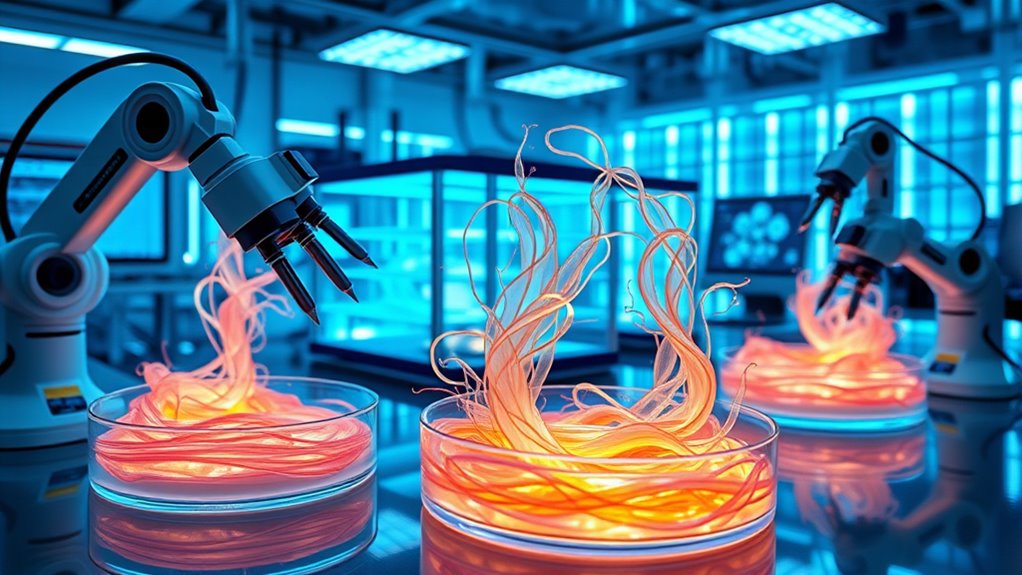

Biofabrication combines biology and engineering to grow leather and fibers directly in labs, offering sustainable and customizable alternatives to traditional materials. By using synthetic biology, scientists reprogram cells and create scaffolds that foster the growth of durable, leather-like tissues and fibers. This innovative process reduces environmental impact and enhances production efficiency. If you continue exploring, you’ll uncover how this cutting-edge technology is transforming industries and shaping a more eco-friendly future.
Key Takeaways
- Biofabrication combines biology and engineering to produce lab-grown leather and fibers through tissue engineering and synthetic biology.
- Techniques like scaffolding and bioprinting guide living cells to form durable, leather-like materials.
- Synthetic biology reprograms cells to enhance collagen and fiber production for customized, sustainable materials.
- Lab-grown leather and fibers reduce environmental impact, ethical concerns, and resource consumption compared to traditional methods.
- Advances in biofabrication enable scalable, high-quality production for diverse applications in fashion, upholstery, and technical textiles.

Biofabrication is a cutting-edge field that combines biology, engineering, and materials science to create functional biological tissues and structures. As you explore this innovative area, you’ll find that synthetic biology plays a vital role in designing living materials that can mimic natural tissues. Synthetic biology allows scientists to reprogram cells or engineer new biological parts, enabling the production of complex tissues like leather and fibers directly in the lab. These advancements are transforming how we think about manufacturing, moving away from traditional animal farming or synthetic substitutes toward more sustainable, lab-grown alternatives.
In the domain of tissue engineering, biofabrication leverages precise techniques to assemble living cells into structured tissues. For growing leather and fibers, tissue engineering involves creating scaffolds that support cell growth and differentiation. You might imagine a scaffold as a tiny framework that guides cells to grow in specific patterns, ultimately forming a durable, leather-like material. This process not only replicates the natural texture and strength of animal leather but also reduces environmental impact and ethical concerns associated with traditional livestock farming. As you get involved in this technology, you’ll appreciate how biofabrication can produce customizable, eco-friendly materials tailored to particular uses.
The process begins with sourcing or engineering cells capable of producing collagen and other structural proteins essential for leather and fiber formation. Using bioprinting or other deposition methods, these cells are layered onto scaffolds, where they proliferate and produce extracellular matrix components. Thanks to advances in tissue engineering, you can control the environment around these cells—adjusting factors like nutrient supply, oxygen levels, and mechanical stimuli—to optimize the quality and consistency of the final product. This control guarantees that lab-grown leather or fibers meet industry standards for durability and appearance, all while minimizing waste and resource consumption.
Furthermore, synthetic biology enables you to modify cells to enhance their production capabilities, making the process more efficient and scalable. You might tweak genetic pathways to increase collagen output or improve the fibers’ flexibility. This ability to tailor biological systems means biofabricated materials can be designed for specific applications, whether for fashion, upholstery, or technical textiles. Additionally, the integration of personal development tools like goal setting and self-reflection can help innovators stay motivated and focused on sustainable advancements in this field. As you work within this space, you’ll see how biofabrication not only offers a sustainable alternative but also opens up possibilities for innovation in material design that were previously unimaginable.
Top picks for "biofabrication grow leather"
Open Amazon search results for this keyword.
As an affiliate, we earn on qualifying purchases.
Frequently Asked Questions
How Long Does It Take to Produce Lab-Grown Leather?
It typically takes several weeks to produce lab-grown leather, depending on the process and scale. While this method offers cost efficiency by reducing material waste and ethical concerns, technological hurdles still exist, like optimizing growth conditions and scaling up production. You’ll find that advancements are speeding up, but the timeline can vary based on the specific techniques used and the desired quality of the final product.
What Are the Environmental Impacts of Biofabricated Materials?
Think of biofabricated materials like a revitalizing gust for the environment. They generally reduce your carbon footprint and support sustainable practices by using fewer resources and generating less waste compared to traditional methods. These innovations can lower pollution and decrease reliance on fossil fuels. Overall, adopting biofabricated materials benefits the planet, helping you make eco-friendly choices while enjoying durable, high-quality products.
Are Lab-Grown Fibers as Durable as Traditional Ones?
Lab-grown fibers can match traditional ones in durability, thanks to synthetic strength that enhances their resilience. You’ll find they often offer comparable fiber flexibility, making them suitable for various applications. Advances in biofabrication improve their ability to withstand wear and tear, ensuring they’re a viable, eco-friendly alternative without sacrificing performance. So, if you’re seeking sustainable options, lab-grown fibers could be just as reliable as traditional fibers in your projects.
Can Biofabrication Be Scaled for Mass Production?
You can scale biofabrication for mass production, but scaling challenges remain significant. Manufacturing feasibility depends on optimizing the growth processes, reducing costs, and ensuring consistent quality at larger volumes. While advances are promising, you’ll need to address these hurdles to make lab-grown leather and fibers commercially viable on a large scale. With continued research, biofabrication could become a sustainable and practical alternative to traditional manufacturing methods.
What Are the Main Challenges in Biofabricating Leather?
You face hurdles like ethical concerns and material consistency when biofabricating leather. While it’s a promising eco-friendly option, ensuring the process respects animal welfare without compromise can be tricky. Achieving uniform quality is another challenge, as tiny variations can impact durability and appearance. These obstacles demand careful refinement, so you can confidently produce lab-grown leather that’s sustainable, reliable, and ethically sound, paving the way for broader acceptance.
Conclusion
So, as you see, biofabrication is revolutionizing how we create leather and fibers right in labs, turning science fiction into reality. Imagine a future where your wardrobe is made from sustainable, lab-grown materials that save the planet—it’s like having a superpower! This technology is growing faster than you can say “eco-friendly,” and it’s shaping a world where fashion and sustainability go hand in hand. Embrace this innovation—your wardrobe, and the Earth, will thank you!